- Manufactured in the USA
- Batch Produced, Batch Tested
- Secure Laboratory Packaging
- Affordable Pricing
- 24/7 Support
- Manufactured in the USA
- Batch Produced, Batch Tested
- Secure Laboratory Packaging
- Affordable Pricing
- 24/7 Support
- Manufactured in the USA
- Secure Laboratory Packaging
- Affordable Pricing
- 24/7 Support
- Manufactured in the USA
- Batch Produced, Batch Tested
- Secure Laboratory Packaging
- Affordable Pricing
- 24/7 Support
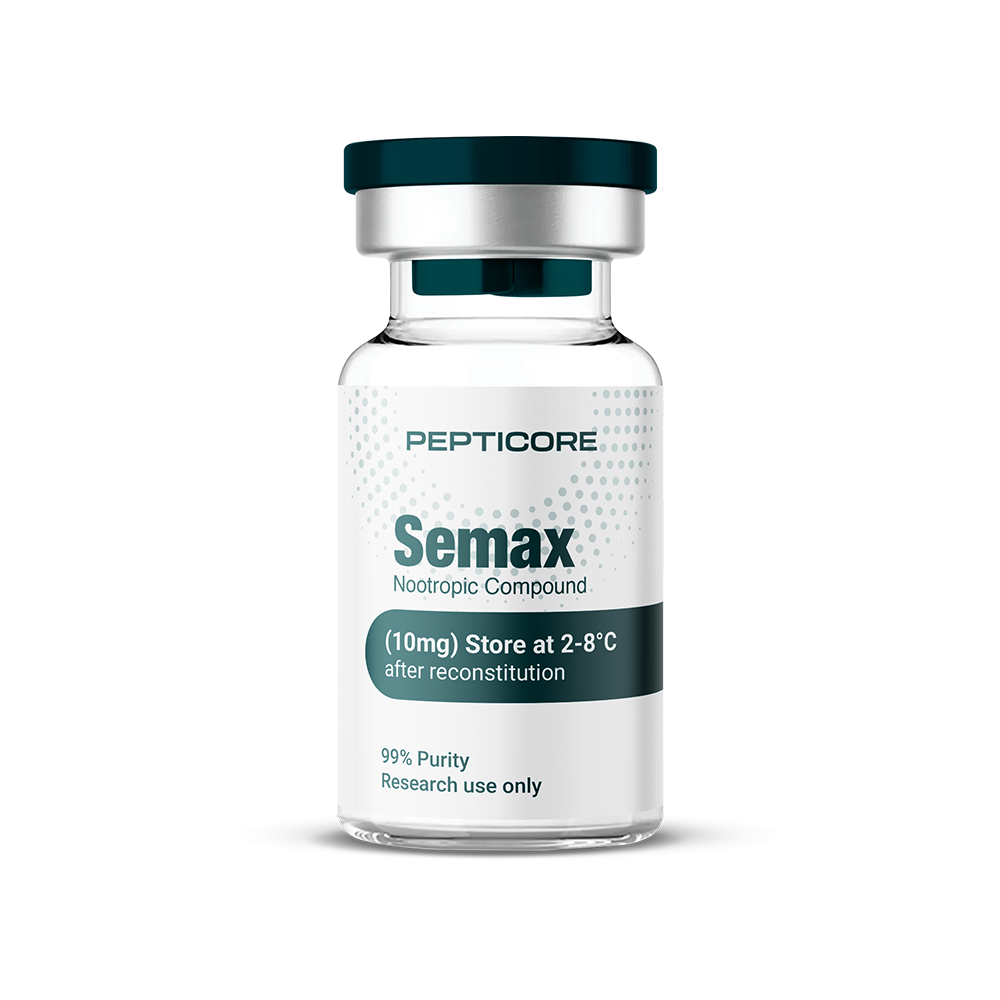
Semax
CAS: 80714-61-0
Research Use Only
Products are intended exclusively for laboratory and analytical research purposes. By purchasing, customers acknowledge responsibility for compliance with applicable laws and regulations.
Semax Overview
Semax is a synthetic heptapeptide examined in preclinical research models for its interactions with neurotrophin receptor constructs and intracellular signaling pathways in vitro. Published studies have investigated its binding characteristics across neuronal cell culture assay formats. Pepticore supplies this compound exclusively as a laboratory reference material. No biological outcomes or suitability for human use is implied or established.
Semax History
Semax was developed during synthetic peptide research in the 1980s–1990s, examining structural analogs of the ACTH 4-10 sequence. It was designed as a non-hormonal synthetic peptide fragment for laboratory investigation of peptide-receptor binding constructs. Subsequent peer-reviewed research has examined its structural binding properties across neuronal receptor assay formats in controlled in vitro settings.
Semax Structure
CAS #: 80714-61-0 Molecular
Formula: C₃₇H₅₁N₉O₁₀S Molecular
Weight: 834.9 g/mol
PubChem ID: 122767
Semax Research
Peer-reviewed literature has examined Semax's binding characteristics across the following in vitro assay categories:
- Neurotrophin receptor assays: TrkB receptor binding and interaction profiling
- Neuronal cell culture models: peptide-receptor signaling pathway studies
- Intracellular signaling assays: MAPK and PKA pathway interaction modeling
- Oxidative stress assay models: reactive oxygen species interaction studies
All findings referenced here are sourced from third-party peer-reviewed publications. Pepticore makes no independent claims regarding biological activity, efficacy, or outcomes for this compound.
Semax References
Published literature examining Semax's structural binding properties is accessible via PubMed (CAS: 80714-61-0).


